Why String theory won’t go away
If you’ve heard of String Theory outside of a physics classroom, it was probably mentioned with a sarcastic eye-roll or remembered vaguely as a fad that scientists were excited about before it faded into obscurity.

If you’ve heard of String Theory outside of a physics classroom, it was probably mentioned with a sarcastic eye-roll or remembered vaguely as a fad that scientists were excited about before it faded into obscurity.
If you actually work in physics, however, your experience is entirely different. To this day, if you want to start a fight at a conference, just make a bold claim about String Theory declaring it either the undeniable truth or complete rubbish. Instantly, the room will divide, and everyone will feel compelled to defend their stance. You might have even had a professor tell you that "serious physicists no longer study String Theory" (which is untrue).
Whatever your experience, String Theory brings out strong opinions. For nearly 60 years, people have been calling it garbage, and for exactly as long, brilliant minds have been fiercely defending it. So, if it has been six decades without a single major, testable breakthrough, why won't String Theory simply go away?
What is String Theory?
To understand why String Theory refuses to die, we first need to understand what it actually is and the massive problem it is trying to solve. String Theory is a primary candidate for a "unified field theory" a theoretical framework designed to explain all the fundamental forces of nature (gravity, electromagnetism, the strong nuclear force, and the weak nuclear force) within a single, overarching mathematical equation. Currently, physics is split into two highly successful, but fundamentally incompatible, frameworks:
- Gravity is described by Einstein’s General Theory of Relativity.
- The other three forces (strong, weak, and electromagnetic) are described by the Standard Model of particle physics, which relies on Quantum Field Theory.
All previous attempts to merge these two theories have failed. To see why, we have to look at how differently they describe reality.
The Smooth World of General Relativity
In General Relativity, gravity is described as a geometric property of four-dimensional spacetime. Specifically, the curvature of that spacetime is directly dictated by the energy, momentum, and mass of whatever is present inside it, including matter and radiation. This relationship is governed by the Einstein field equations:
$$G_{\mu\nu} + \Lambda g_{\mu\nu} = \kappa T_{\mu\nu}$$ where \(G_{\mu\nu}\) is the Einstein tensor, \(g_{\mu\nu}\) is the metric tensor, \(T_{\mu\nu}\) is the stress–energy tensor, \(\Lambda\) is the cosmological constant and \(\kappa\) is the Einstein gravitational constant. The key takeaway from this equation and its associated tensors is that Einstein's universe is smooth, continuous, and constant.
The Jumpy World of Quantum Mechanics
In Quantum Field Theory, the universe's other three forces are described as a collection of foundational "fields" permeating all of spacetime. Particles are simply localized vibrations or excitations of these fields.
The Standard Model of particle physics categorizes all matter into 12 fundamental particles (fermions), governs them through forces mediated by other particles (bosons), and explains mass through the Higgs field. If you want to write this out mathematically, it looks like a sprawling monstrosity of symbols.
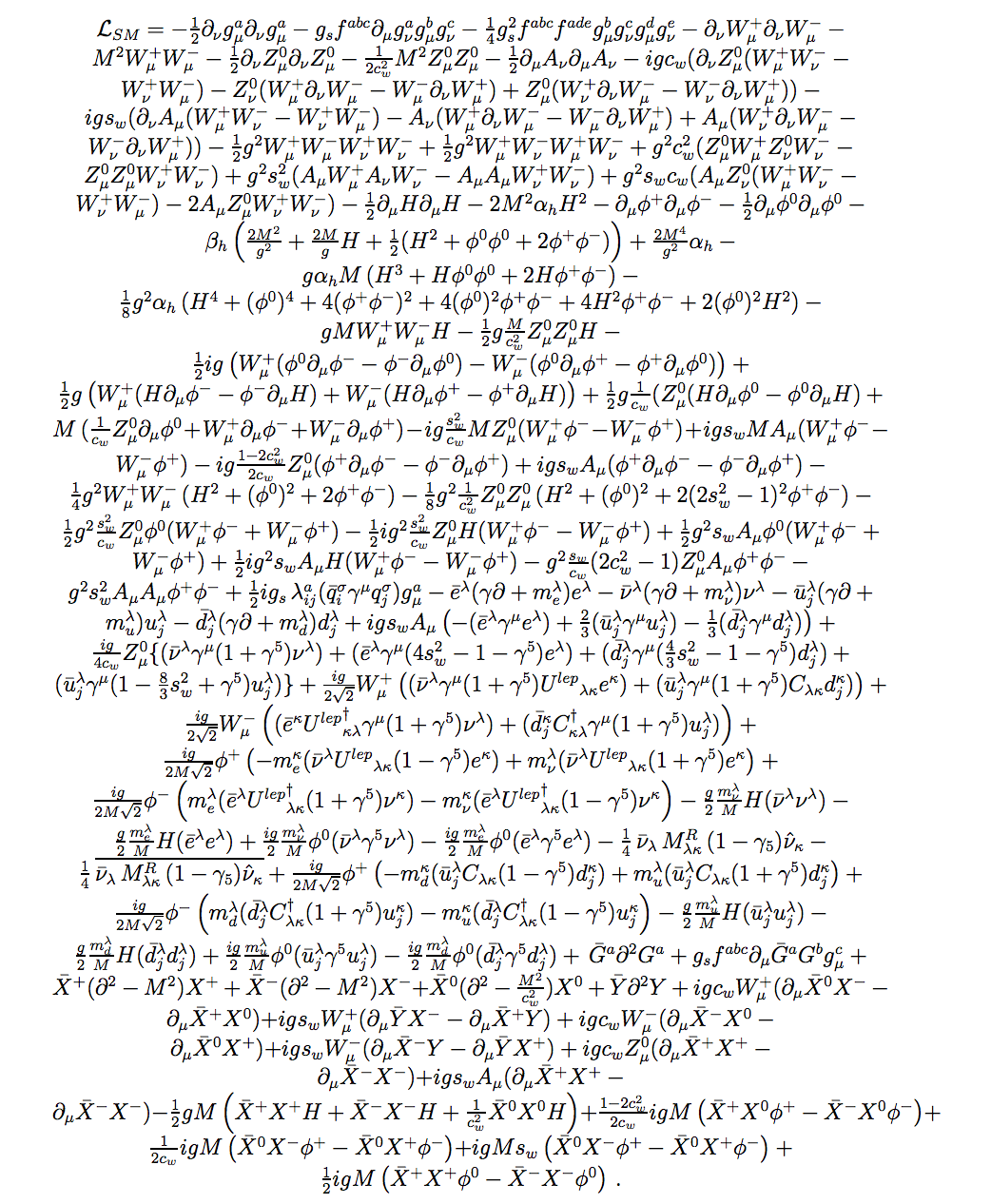
However, that massive equation can be simplified into the Standard Model Lagrangian (the difference between the kinetic and potential energy of a system):
$$L = \frac{-1}{4}F_{\mu\nu}F^{\mu\nu} + i\bar{\psi}D\psi + h.c + \bar{\psi}_{i}y_{ij}\psi_{j}\phi + h.c + |D_{\mu}\phi|^2 -V(\phi)$$ this equation dictates exactly how fundamental particles and forces behave. Here is how the pieces fit together:
- \(-\frac{1}{4}F_{\mu\nu}F^{\mu\nu}\): Describes the mathematics of electromagnetism, the strong force, and the weak force, as well as how force-carrying bosons interact with one another.
- \(i\bar{\psi}D\psi + h.c\) : Describes the fields for the 12 fundamental matter particles (quarks and leptons, like electrons) and how they interact with the forces described above.
- \(\bar{\psi}_{i}y_{ij}\psi_{j}\phi + h.c\): Describes how matter particles acquire their mass by interacting with the Higgs field.
- \(|D_{\mu}\phi|^2 - V(\phi)\): Details the behavior of the Higgs boson and how its self-interaction gives mass to the force-carrying W and Z bosons.
The Mathematical Collision
The problem is that the fields in Quantum Field Theory are discrete and probabilistic. They operate on mathematics that are fundamentally at odds with the smooth, continuous manifolds of General Relativity.
Because of this, physicists cannot easily bridge the math of these two realms. If you try to calculate the interaction of gravity at the quantum level using both mathematical frameworks at the same time, the math breaks down entirely. Instead of usable predictions, the equations yield nonsensical infinities a fatal theoretical flaw known as non-renormalizability. Enter String Theory which attempts to reconcile these two realities by replacing the zero-dimensional, point-like particles of the Standard Model with tiny, one-dimensional "strings."
Instead of distinct particles, String Theory describes how these strings move through space and interact with each other via vibrations. On distance scales larger than the string itself, a string looks and acts exactly like a particle. Its mass, charge, and other properties are entirely determined by its specific vibrational state much like how different vibrations on a guitar string produce different notes.
This fundamental shift smears out the mathematical infinities that arise when trying to combine gravity with the quantum realm, allowing both theories to operate peacefully in a single framework. Furthermore, in String Theory, one of the many vibrational states of the string perfectly corresponds to the graviton, the hypothetical quantum mechanical particle that carries the gravitational force.
This makes String Theory a fully functional theory of quantum gravity that is purely geometric, just like General Relativity. But as we are about to see, this mathematical elegance comes at a steep cost.
Why Physicists Don’t Like String Theory
As mentioned previously, if you try to calculate the interaction of gravity at the quantum level using the frameworks of both General Relativity and Quantum Field Theory, the math simply stops working. Instead of usable predictions, the equations spit out nonsensical infinities (non-renormalizability). Worse, the equations lose Lorentz invariance, meaning the fundamental laws of physics would start to vary depending on your frame of reference, orientation, or speed.
In String Theory, the equation governing the vibration of the strings contains a specific mathematical term that perfectly balances out those invalid, nonsensical values, restoring the theory's renormalizability. It’s an elegant fix, but there is a massive catch: for this term to function properly, the math dictates that the universe must have a very specific number of dimensions.
And that number is not four.
Depending on the exact formulation, String Theory requires between 10 and 26 dimensions. The most widely studied variant M-theory requires 11 dimensions (10 of space and 1 of time). This brings us to the most glaring problem with String Theory: we only observe 4 dimensions in our universe (3 of space, 1 of time). So, where are the extra dimensions? String Theory proposes that they are compactified. This means these extra dimensions are rolled up so tightly on the incomprehensible scale of \(10^{-33}\) cm that they are completely imperceptible to human senses and modern instruments.
We are left with a theoretical framework that accurately mathematically describes the laws of our universe, but features a physical reality that is completely alien to our own. Because its core features (like strings and microscopic dimensions) are too small to ever truly be observed, critics argue the theory is fundamentally untestable.
This leads to the ultimate physicist insult. Many argue String Theory is "not even wrong." Because it makes no new, testable predictions, critics claim it shouldn't even be considered a scientific theory at all. Yet, for a theory that so many have dismissed as blatantly unscientific, it has proven to be remarkably hard to kill.
Why It Won’t Go Away
The first, and perhaps most prominent, reason String Theory persists is the simplest: it accurately describes the universe as we know it, just not necessarily as we naturally visualize it.
When you "zoom out" and apply String Theory's math to low-energy, macroscopic environments (scales much larger than the tiny strings), its complex equations perfectly simplify into Einstein’s General Relativity. Remarkably, gravity is not "manually added" into String Theory to make it work, it naturally emerges because the theory inherently predicts the existence of a massless, spin-2 particle called the graviton.
Conversely, if you observe the universe at the quantum level where gravitational effects are negligible String Theory's equations simplify right back into the Lagrangian for the Standard Model of particle physics. It successfully encompasses everything we already know to be true.
The Ultimate Mathematical Multi-Tool
String Theory also sticks around because it is incredibly useful. As a working theory of quantum gravity, it allows physicists to explore extreme environments where both quantum mechanics and gravity are necessary most notably, inside black holes. Currently, String Theory provides one of the best mathematical models for understanding how space and time might emerge from underlying quantum information.
But its usefulness doesn't stop at black holes. To truly understand why String Theory refuses to die, we have to look at its relationship with something called Gauge Theory, and a mind-bending concept known as the holographic principle.
What is Gauge Theory?
At its core, a Gauge Theory is a field theory where the laws of nature remain unchanged (invariant) even when you apply continuous, localized mathematical transformations to them (like changing coordinate units or reference frames). You can alter the representation (the "gauge") of a field at any single point in spacetime without affecting the observable, physical reality.
In nature, these mathematical symmetries require the introduction of compensating fields, which manifest as the fundamental forces. When quantized, the excitations of these fields give us force-carrying particles called gauge bosons (as we saw earlier).
Gauge Theory is the bedrock of the Standard Model. It perfectly describes three of the four fundamental forces using specific mathematical symmetry groups:
- U(1): Governs Quantum Electrodynamics (the electromagnetic force).
- SU(2): Describes the electroweak force.
- SU(3): Describes Quantum Chromodynamics (the strong nuclear force).
Note the absence of Gravity. For decades, no one knew how gravity could possibly fit into Gauge Theory. That is, until 1997, when physicist Juan Maldacena discovered something incredible: Gauge-Gravity Duality (also known as the AdS/CFT correspondence).
The Gauge-Gravity Duality (AdS/CFT)
Gauge-Gravity Duality proposes that a quantum gravity theory in a specific higher-dimensional space is exactly mathematically equal to a non-gravitational quantum theory living on the boundary of that space.
This duality relies on three core principles:
- Bulk vs. Boundary: A quantum gravity theory exists in a higher-dimensional space (the bulk), while a non-gravitational quantum theory exists on the lower-dimensional edge of that higher dimensional space (the boundary).
- The Holographic Principle: Just as a 2D hologram encodes a 3D image, the entire physical content of the gravitational "bulk" is fully encoded by the quantum system on its "boundary."
- Strong-Weak Duality: In Gauge Theory, there is a coupling constant (g) that dictates how strongly fields interact. When coupling is strong, the math becomes a "dark forest" of complex solutions, making it almost impossible to solve. But through this duality, a strongly interacting gauge theory maps directly to a weakly interacting gravity theory.
What this means is that physicists can take an impossibly difficult, strongly coupled quantum problem, translate it into a simpler problem, solve it, and translate the answer back. This allows us to study the behavior of quarks, gluons, and superconductors using mathematics originally developed for understanding black holes.
The Ultimate Punchline
If this elegant translation between different types of physics sounds familiar, it should. As physicists explored Gauge-Gravity Duality, they kept finding connections back to String Theory.
For example, the KSS viscosity bound a proposed universal lower limit for the ratio of shear viscosity \((\eta)\) to entropy density (S) in physical fluids naturally emerges from the gravity side of Gauge Theory. However, this exact constant was first discovered years earlier while using String Theory to study the behavior of black holes. Gauge field theorists have never been able to derive this duality on their own using only Gauge theory. Even today, theorists have still been unable to derived a proof of Gauge-Gravity Duality purely from within Gauge Theory itself, but the mathematics behind String Theory was able to handle it.
This is the key to String Theory’s staying power. It isn't just that String Theory is useful; it's that standard quantum theories are hiding incredibly deep, complex geometric structures and somehow, String Theory already knew about them. It has repeatedly revealed hidden architectures of the universe that our conventional tools cannot carve out on their own.
So despite the sneering, the ridicule, and its seemingly untestable physical nature, String Theory simply understands the deep math of the universe too well to simply go away...not with out a fight at least. Stay tuned to see what else we’re cooking up here at The Puttering Dev!